
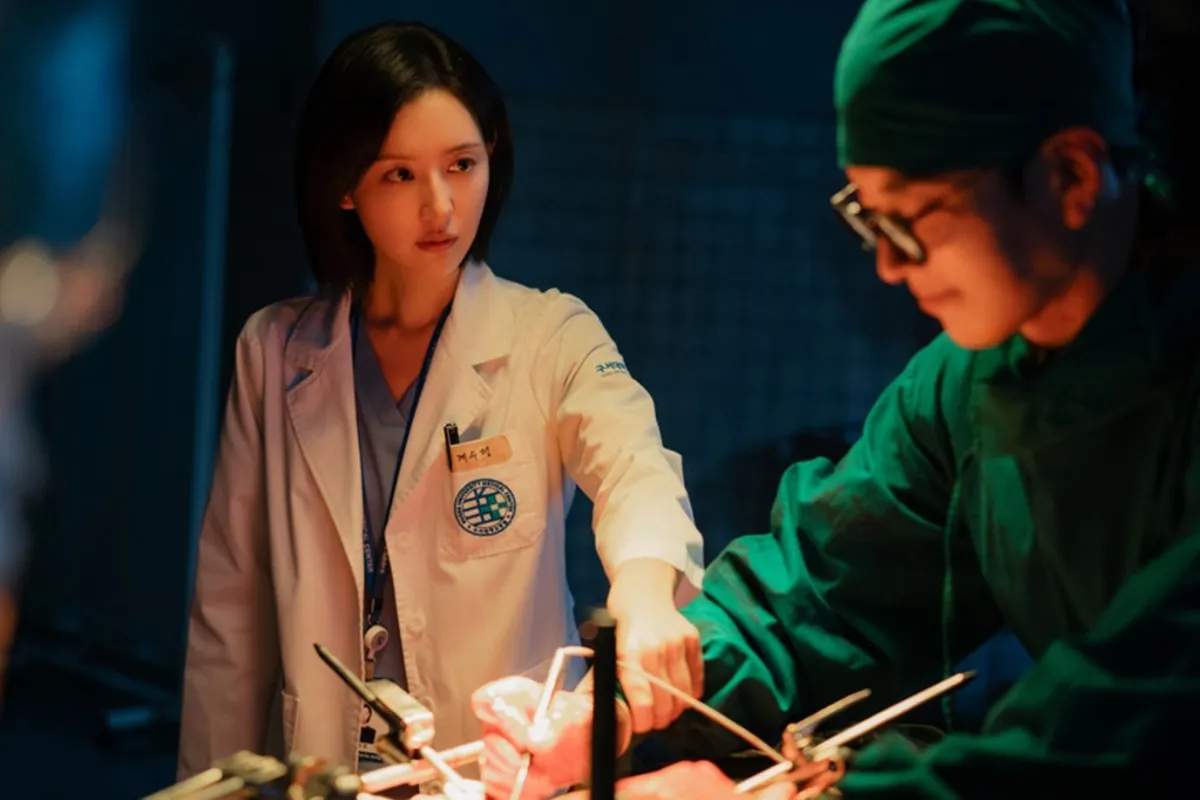
Doctor X: Mafia in White Season 1 Episode 6, titled “The Patient Who Said No,” brings a difficult medical case to the center of the story. Gye Su-jeong takes on the case of Oh Sang-beom, an elderly man who has lived with bullet fragments in his head for decades. However, the real challenge is not just the surgery. Sang-beom carries deep guilt over his past, while the hospital’s leaders are more concerned about money, reputation, and political pressure than his recovery.
The episode connects a personal tragedy to South Korea’s troubled history. It also shows how a hospital can fail its patients when powerful people treat medical care as a business. Here is a complete recap, along with an explanation of the episode’s ending and its main themes.
What Happens in Doctor X: Mafia in White Episode 6?
Su-jeong’s Past and a Boy’s Desperate Request
The episode opens with a flashback to Su-jeong’s time in Lagota. During a dangerous encounter with soldiers, a young boy named Baraka helps her and asks for her assistance. His younger sister, Neema, has been shot in the head, and he believes Su-jeong is the only doctor who can save her.
Despite the danger around them, Su-jeong agrees to help. She carries Baraka with her and promises that he will see his sister again. The scene offers a glimpse of the doctor she has always been beneath her tough personality. She may be blunt and difficult to deal with, but she does not turn away when someone genuinely needs her help.
This memory becomes important later in the episode. Su-jeong must face another patient whose physical injuries are tied to a painful past. Both cases force her to look beyond medical reports and consider the people living with the consequences of violence.
The Hospital Faces Pressure Over Sang-beom’s Surgery
At Guseo University Medical Center (GUMC), the doctors face an unusual and risky case. Oh Sang-beom has lived for decades with bullet fragments lodged in his skull. He suffers from seizures and other neurological problems, but he has repeatedly refused treatment.
His condition dates back to the Gwangju Democratic Uprising in May 1980, when military forces violently suppressed a pro-democracy movement. Sang-beom was shot during the unrest, and his brother disappeared during the same traumatic period.
Several attempts to remove the bullet fragments have failed. The operation is dangerous, and there is no guarantee that Sang-beom will survive. Director Bu initially refuses to take the risk, partly because a failed procedure could damage the hospital’s reputation.
However, powerful figures, including members of the Magnolia Society, pressure the hospital to handle the case. GUMC is already struggling with financial problems, and its leadership is worried about losing support from influential people.
Su-jeong volunteers to perform the surgery. Director Bu sees this as an opportunity to get rid of her if the operation fails. He believes the hospital can satisfy its powerful visitors while making Su-jeong responsible for any disaster.
Hee-sook Warns Su-jeong About the Trap
Director Bu and Dr. Do attempt to secure Hee-sook’s cooperation with cash payments. Hee-sook is not satisfied with the amount because she understands the risks involved. Director Bu promises additional money if Su-jeong completes the surgery.
Later, Hee-sook warns Su-jeong that the hospital intends to use her as a scapegoat. If something goes wrong, the senior doctors will be able to blame her rather than accept responsibility themselves.
Su-jeong understands the danger but continues with the case. Her decision shows that she is willing to take risks for a patient, even when the people around her have their own interests in mind. At the same time, the episode makes it clear that she is working inside a system where medical decisions are often shaped by money and power.
Also Read: Lupin Season 4 Recap and Ending Explained
Sang-beom’s Painful History Comes to Light
Su-jeong, Tae-kyeong, Won-jin, and Hee-sook travel to Sang-beom’s hometown to learn more about him. During the journey, Su-jeong dreams about the day he was injured.
In the flashback, Sang-beom is trying to buy shoes for his brother when protests break out. He attempts to protect his brother during the violence but is shot in the head. The incident leaves him with a lasting injury and a deep sense of guilt.
Sang-beom has spent much of his life isolated from the outside world. He believes that his brother’s fate was his fault, and he refuses to seek treatment because he feels he deserves to suffer. His doctor and friends try to encourage him to keep living, reminding him that the victims of the violence should not be forgotten.
When Sang-beom travels to Seoul for surgery, it becomes clear how limited his life has been. He explains that it is his first train journey in many years and admits that guilt has kept him from leaving his hometown.
His story gives the episode much of its emotional weight. Sang-beom is not simply an elderly patient with a difficult medical condition. He is a survivor who has spent decades trapped by memories he cannot escape.
Hospital Politics Take Priority Over the Patient
Before the operation, members of the Magnolia Society and other influential visitors arrive to see Sang-beom. They congratulate him and take photographs with him, using his story to present themselves in a positive light.
Su-jeong is angered by their behavior. She refuses to let them treat her patient like a public relations opportunity and tells them to leave. Won-jin also helps remove the visitors from the room.
The scene highlights one of the episode’s main problems: the people in charge seem more interested in appearances than in the patient’s well-being. Sang-beom has endured years of pain, yet the hospital’s powerful guests appear concerned with the attention they can gain from his case.
Director Bu later tells Su-jeong that she does not understand how the real world works. His comment reflects the difference between them. Su-jeong believes a doctor’s first duty is to the patient, while the hospital leadership sees influence and reputation as essential parts of its survival.
Why Sang-beom Refuses the Operation
Su-jeong carefully explains Sang-beom’s medical condition and the possible benefits of surgery. Removing the bullet fragments could reduce his symptoms, including the visions and hallucinations connected to his injury.
However, Sang-beom learns that the operation may stop him from seeing the image of his brother that he has continued to experience. For someone who has spent decades carrying guilt over his brother’s disappearance, that possibility is frightening.
He refuses to go ahead with the procedure. His decision is not simply a rejection of medical advice. The hallucinations are connected to the last emotional link he believes he still has with his brother. Losing them feels like losing his brother all over again.
This creates a difficult situation for Su-jeong. Surgery may improve his physical condition, but she cannot ignore the emotional meaning it has for him. The episode asks whether saving a patient’s life is enough if the doctor fails to understand what that patient is afraid of losing.
Sang-beom Disappears From the Hospital
That night, Sang-beom leaves his room. Tae-kyeong discovers that he is missing, and the doctors begin searching for him. They check the hospital’s security footage and try to work out where he has gone.
Meanwhile, Su-jeong learns that a former president, Ji Du-seok, has been rushed to GUMC by helicopter. The hospital quickly prepares to receive the high-profile patient, and Sang-beom’s place in the VIP section is suddenly under threat.
Su-jeong rushes back after Tae-kyeong tells her about Sang-beom’s disappearance. She eventually discovers that he is on the rooftop and appears ready to jump. His emotional condition has become increasingly dangerous, and the doctors must act quickly.
Also Read: Surviving Hurricane Otis Movie 2026 Recap and Ending Explained
| Detail | Information |
|---|---|
| Series | Doctor X: Mafia in White |
| Season | Season 1 |
| Episode | Episode 6 |
| Episode Title | The Patient Who Said No |
| Release Date | October 24, 2026 |
| Genre | Medical drama, Korean drama, social drama |
| Main Character | Gye Su-jeong |
| Central Patient | Oh Sang-beom |
| Main Conflict | A dangerous operation, a patient’s painful past, and corruption within the hospital |
| Key Historical Event | The Gwangju Democratic Uprising of May 1980 |
| Streaming Platform | Netflix in selected regions |
Doctor X: Mafia in White Episode 6 Ending Explained
The episode ends with Sang-beom reacting strongly to the arrival of the helicopter. As he sees it, memories of the violence that destroyed his life come rushing back. He begins shouting as he remembers what happened to his brother during the Gwangju uprising.
The ending does not provide a simple resolution to his case. Instead, it leaves the audience with an urgent question: can Su-jeong help a patient who has lost the will to live, even when his medical condition may be treatable?
Sang-beom’s reaction also connects his personal trauma to the wider historical tragedy. The helicopter is not just a vehicle arriving at a hospital. It reminds him of the military violence that changed his life decades earlier.
Su-jeong’s memory of Baraka and Neema adds another layer to the ending. Baraka trusted her to save his sister, and she accepted that responsibility despite the danger. Now she faces Sang-beom, who needs medical help but is unable to move beyond his guilt. The episode ends before she can fully resolve this challenge.
Also Read: Nobody Wants This Season 3 Recap and Ending Explained
What Is the Historical Background of Sang-beom’s Story?
Sang-beom’s past is linked to the Gwangju Democratic Uprising, also known as the May 18 Democratic Movement. In May 1980, citizens in Gwangju, South Korea, protested against military rule and demanded democratic change. Military forces violently suppressed the movement, killing and injuring civilians.
The uprising became a major event in South Korea’s struggle for democracy. It also left lasting trauma among survivors and families who lost loved ones. The Library of Congress provides historical information about the uprising and its role in the country’s democratization movement.
In Doctor X: Mafia in White, Sang-beom represents people whose lives were permanently changed by that period. His injury is physical, but his guilt and isolation show how the effects of political violence can continue long after the fighting has ended.
The show uses a fictional patient to explore the lasting human cost of historical violence. It is important to distinguish Sang-beom’s individual story from the real historical record, but the historical setting gives his suffering a deeper meaning.
Also Read: The Terminal List Season 2 Recap and Ending Explained
Review: Is Doctor X: Mafia in White Episode 6 Worth Watching?
Episode 6 is a thoughtful chapter that combines a medical emergency with a story about trauma, guilt, and the misuse of power. Sang-beom’s case gives Su-jeong a challenge that cannot be solved by surgical skill alone. She must also understand why he refuses treatment and what his past means to him.
The strongest part of the episode is its portrayal of Sang-beom’s emotional struggle. His refusal to undergo surgery makes sense once viewers understand his connection to his missing brother. The story shows that people do not always make decisions based only on what is medically best for them. Fear, memory, and guilt can be just as powerful.
Su-jeong remains the episode’s driving force. Her refusal to let powerful visitors use Sang-beom for publicity reinforces her belief that patients deserve dignity. Her clashes with Director Bu also keep the conflict between medical ethics and hospital politics alive.
However, the episode has some weaknesses. The hospital’s leaders sometimes behave in an overly obvious way, making the conflict between good medical care and corruption feel familiar. The dream sequence that places Su-jeong inside Sang-beom’s memories is also an unusual storytelling choice that may not work for every viewer.
Even so, the episode succeeds because it gives its central patient a personal history rather than treating him as just another difficult case. The ending creates genuine concern for Sang-beom and leaves Su-jeong facing one of her most complicated challenges yet.
Sang-beom refuses surgery because he believes he is responsible for his brother’s disappearance. He also fears that removing the bullet fragments will stop him from seeing his brother in his hallucinations.
Gye Su-jeong is the main doctor in the series. She is known for her strong personality, medical skills, and determination to put patients first, even when her decisions bring her into conflict with hospital leaders.
The Gwangju Democratic Uprising was a pro-democracy movement in South Korea in May 1980. Military forces violently suppressed the protests, leaving many people dead or injured. The event plays an important role in explaining Sang-beom’s trauma and guilt.
Sang-beom refuses the operation after learning that it could affect his hallucinations of his brother. His decision creates a serious problem for Su-jeong, and the episode ends before his medical treatment is resolved.