
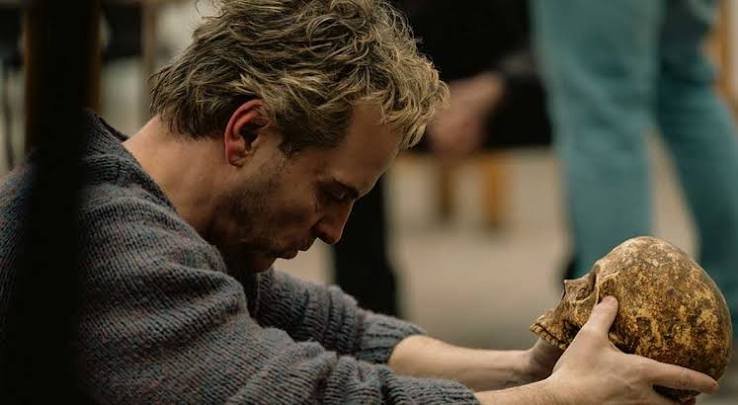
Directed by Simon Stone, Elsinore is based on the final months of Charleson’s life in 1989. It explores his struggle with a deadly illness, his love for theater, and the prejudice faced by gay men during the AIDS epidemic. Although the story ends in tragedy, the film is also filled with humor, friendship, and moments of unexpected happiness.
Elsinore (2026) Movie Recap
Ian Charleson Gets the Opportunity of a Lifetime
The story takes place in London in 1989. Ian Charleson (Andrew Scott) is a talented Scottish actor who once found success in the Oscar-winning film Chariots of Fire. However, he has struggled to build a bigger film career and remains frustrated that people continue to remember him for the same old role.
Ian has always dreamed of playing Prince Hamlet in William Shakespeare’s famous tragedy. Unfortunately, his dream seems out of reach. The National Theatre already has Daniel Day-Lewis playing the lead character in its production of Hamlet.
Everything changes when Day-Lewis unexpectedly leaves the production after walking offstage during a performance. Director Richard Eyre (Johnny Flynn), who knows Ian, approaches him about taking over the role.
Ian immediately recognizes the opportunity. Playing Hamlet at the National Theatre is something he has wanted since childhood. But there is one serious problem: Ian is HIV-positive, and his health is getting worse.
He tells Richard about his condition and admits that he might not survive long enough to perform. Despite the risk, Richard decides to give him the role.
Ian’s Health Becomes a Serious Concern
Ian’s excitement is mixed with fear. He has been living with HIV, but the disease is progressing. He notices a purple lesion on his temple, a warning sign of the damage being done to his immune system.
He receives treatment from Dr. Margaret Johnson (Olivia Colman), a specialist working with HIV and AIDS patients. She understands the seriousness of his condition and worries that the physical demands of performing Hamlet could make things worse.
Hamlet is not an easy play. It requires long hours of rehearsal, intense concentration, and enormous physical energy. For someone already suffering from a life-threatening illness, the role could be dangerous.
Dr. Johnson wants Ian to protect his remaining strength. Ian, however, sees the situation differently. He does not want to spend whatever time he has left simply waiting for death.
He wants to do something meaningful with his life, even if it comes at a personal cost.
Why Does Ian Buy the Elsinore Motorcycle?
One of the film’s most meaningful moments occurs when Ian visits a vehicle dealership. He needs transport to move between rehearsals and his medical appointments.
While looking around, he notices a Honda Elsinore motorcycle. The name immediately catches his attention because Elsinore is also the name of the Danish castle associated with Shakespeare’s Hamlet.
The dealership owner initially refuses to sell the motorcycle because it is his prized possession. However, the next scene shows Ian riding it home.
The film never explains exactly how Ian persuaded the owner. Instead, the moment shows how strongly Ian believes in his dream.
For Ian, finding a motorcycle named Elsinore feels like a sign that he is moving in the right direction. He is no longer just preparing to play Hamlet. He is beginning to see his own life through the story of the character.
Ian Struggles With His Identity and the Fear of Being Exposed
Alongside his illness, Ian faces another difficult struggle. He is gay, but he has kept his sexuality and medical condition private because he fears losing acting opportunities.
During the late 1980s, HIV and AIDS were surrounded by fear, misinformation, and discrimination. Many people wrongly associated the disease only with gay men, while patients often faced rejection and isolation.
Ian’s friend Derek Jarman (David Dawson), an openly gay filmmaker who is also living with HIV, challenges his decision to remain silent.
Derek believes that public figures should speak openly about the epidemic. He wants people to understand that those living with HIV are human beings with families, relationships, and dreams.
Ian disagrees. He fears that revealing his condition will change how audiences see him. Instead of judging his acting, people might focus entirely on his illness.
Their disagreement reveals one of the film’s central conflicts. Derek believes that visibility can fight prejudice, while Ian wants to protect his career and his right to privacy.
Neither man is free from fear. They are simply responding to the same crisis in different ways.
Ian Finds Support From His Friends and Fellow Actors
As rehearsals continue, Ian’s physical condition becomes harder to hide. He struggles with exhaustion and the side effects of treatment, but he refuses to abandon the production.
His close friend Patsy (Billie Piper) becomes an important source of support. She looks after him, prepares food, and helps him manage daily life when his strength begins to disappear.
Richard Eyre and members of the theater company also support Ian. His fellow actors include those playing Gertrude, Ophelia, Polonius, and the ghost of Hamlet’s father.
Ian’s relationships with his own parents are more complicated. They do not fully understand the private struggles he has been carrying. His father, in particular, represents a world in which men often find it difficult to speak openly about fear, love, and vulnerability.
The film also shows Ian spending time with other AIDS patients. In one memorable hospital sequence, he creates a lively performance using the song There’s No Business Like Show Business, bringing a little happiness into a place filled with suffering.
These scenes are important because they show that Ian is not defined only by his illness. Even while facing death, he remains funny, affectionate, stubborn, and deeply interested in other people’s lives.
Also Read: Steps 2026 Movie Recap and Ending Explained
Ian’s Emotional Visit to His Former Lover
One of the most painful scenes involves Ian visiting his former lover Georgie (Luke Thompson), who is also seriously ill with AIDS.
Georgie asks Ian whether the love he once felt for him was returned. Ian hesitates before reassuring him that it was.
He also tells Georgie that he is going to survive, even though the situation suggests otherwise.
The scene raises a difficult question about honesty. Ian is an actor who spends his professional life making audiences believe in fictional situations. Here, he uses that same ability to comfort someone he cares about.
His words may not reflect the medical reality, but they give Georgie something he desperately needs in that moment: reassurance.
It also shows how Ian’s understanding of acting extends beyond the stage. Sometimes, he believes, telling someone what they need to hear can be an act of kindness.
| Movie | Elsinore |
|---|---|
| Release Date | November 20, 2026 (US limited theatrical release) |
| Genre | Biographical Drama |
| Director | Simon Stone |
| Writer | Stephen Beresford |
| Main Cast | Andrew Scott, Olivia Colman, Billie Piper, Johnny Flynn, David Dawson, Luke Thompson |
| Andrew Scott’s Role | Ian Charleson |
| Olivia Colman’s Role | Dr. Margaret Johnson |
| Based On | The final months of Scottish actor Ian Charleson’s life |
| Setting | London, 1989–1990 |
| Running Time | 111 minutes |
| Language | English |
| Distributor | Focus Features (US) |
Also Read: Black Clover Season 2 Episode 8 Recap and Ending Explained
Elsinore (2026) Ending Explained: Does Ian Charleson Survive?
No, Ian Charleson does not survive. The film follows his final stage performances and the decline in his health before his death from AIDS-related complications.
As the story approaches its conclusion, Ian continues performing Hamlet despite becoming increasingly weak. The role takes an enormous physical toll on him. He suffers backstage, struggles to recover after demanding scenes, and must rely more heavily on the people around him.
Yet he remains determined to finish what he started.
Ian ultimately performs Hamlet 24 times at the National Theatre. The achievement is remarkable because he manages to complete the run while facing an illness that is steadily destroying his strength.
In the final part of the film, scenes from Hamlet are intercut with moments from Ian’s personal life. The boundary between the actor and the character begins to disappear.
Hamlet is a story about grief, mortality, and the uncertainty of human existence. Ian is confronting those same questions outside the theater.
As the film moves toward its conclusion, the emotional connection between the play and Ian’s life becomes clear. His performance is no longer simply a professional achievement. It is his way of facing death without allowing fear to control his final days.
The story concludes with the knowledge that Ian dies only weeks after his final performances. In real life, Charleson died on January 6, 1990, at the age of 40.
His death makes the ending tragic, but the film does not present his final months as a failure. Instead, it emphasizes what he accomplished while he was still alive.
Also Read: Tulsa King Season 4 Episode 6 Recap and Ending Explained
What Does the Final Hamlet Scene Mean?
The final Hamlet sequence brings together the film’s two central stories: Ian’s life and Shakespeare’s tragedy.
Throughout the movie, Ian has been trying to separate his professional identity from his illness. He wants audiences to see Hamlet rather than a dying actor.
However, the ending suggests that the two cannot be completely separated. His experiences with illness, fear, friendship, and loss have changed how he understands the character.
When Hamlet speaks about death, those words carry a different meaning because Ian is facing his own mortality.
The film also connects Hamlet’s relationship with Horatio to Ian’s relationships with the people who care for him. Both stories explore the importance of companionship when someone approaches the end of life.
There is another important difference between the actor and the character. Hamlet spends much of the play questioning what he should do. Ian, despite knowing the risks, makes a clear decision to pursue his dream.
In that sense, Ian achieves something that Hamlet struggles to find: the courage to act while time remains.
Why Is the Movie Called Elsinore?
The title has two connected meanings.
First, Elsinore is the English name associated with Helsingør in Denmark, where Shakespeare’s Hamlet is set. The castle represents the world of the play and the role Ian has dreamed of performing.
Second, Elsinore is the name of the Honda motorcycle Ian buys after accepting the role.
The motorcycle becomes a symbol of freedom and determination. It connects his everyday life with his theatrical ambition.
The title also suggests that everyone has a personal Elsinore: a place, ambition, or achievement that gives life meaning.
For Ian, Elsinore is not simply a castle or a motorcycle. It is the chance to perform Hamlet before his time runs out.
Also Read: 9-1-1: Nashville Season 2 Episode 6 Recap
Is Elsinore Based on a True Story?
Yes. Elsinore is based on the final months of Scottish actor Ian Charleson, who was born on August 11, 1949, and became widely known for playing Eric Liddell in the 1981 film Chariots of Fire.
In 1989, Charleson replaced Daniel Day-Lewis in the National Theatre’s production of Hamlet, directed by Richard Eyre.
Charleson was seriously ill at the time, but his performance received extraordinary praise. He appeared in 24 performances before his death on January 6, 1990.
His portrayal of Hamlet became an important part of his theatrical legacy. The Ian Charleson Awards, established in his memory, recognize outstanding classical stage performances by young actors in Britain.
The film draws on these real events while using dramatized conversations and personal moments to explore what Charleson may have experienced.
Elsinore Movie Themes and Hidden Meaning
Choosing How to Live
Ian cannot control his illness, but he can decide how to spend his remaining time. His choice to play Hamlet reflects his desire for a meaningful life rather than simply a longer one.
Art and Reality
As Ian performs Hamlet, the play begins to reflect his own experiences. The film suggests that art can help people understand feelings and situations that are otherwise difficult to express.
Fear and Social Prejudice
Ian’s reluctance to reveal his sexuality and illness reflects the discrimination faced by gay men during the AIDS epidemic. His arguments with Derek Jarman show the tension between personal privacy and public activism.
Friendship and Compassion
Although Ian is the central character, he does not face his final months alone. His friends, doctors, and fellow performers help him continue working when his body can no longer keep up with his determination.
Also Read: Final Table K drama Episode 8 Recap and Ending Explained
Elsinore (2026) Movie Review: Is It Worth Watching?
Elsinore succeeds mainly because of Andrew Scott’s performance. He portrays Ian as a complicated person rather than an idealized tragic hero. Ian can be funny, impatient, proud, frightened, and deeply caring, sometimes within the same scene.
Olivia Colman provides an effective contrast as Dr. Margaret Johnson. Her character understands the medical danger of Ian’s decision, even when she struggles to accept why performing Hamlet matters so much to him.
Billie Piper and David Dawson also add emotional depth. Patsy represents the practical kindness of friendship, while Derek challenges Ian to think about the wider consequences of remaining silent.
The film is not without weaknesses. Its rapid editing and frequent shifts between rehearsals, medical treatment, and personal relationships sometimes leave important moments with too little room to develop. The final stretch, in particular, could have spent more time showing Ian’s celebrated stage performances.
Still, the story works because it never reduces Ian to a helpless victim. His illness is central to the film, but so are his humor, ambition, talent, and relationships.
Elsinore is worth watching for viewers who enjoy true stories, character-driven dramas, and films about the relationship between art and life.
Yes. Ian Charleson dies from AIDS-related complications shortly after his final performances of Hamlet. The ending highlights his courage and dedication to acting despite his worsening condition.
Elsinore refers to the Danish setting of Shakespeare’s Hamlet. It is also the name of the Honda motorcycle Ian purchases in the film. Both represent his dream of playing Hamlet and his determination to enjoy life.
Ian feared that revealing his HIV diagnosis would affect his acting career and change how audiences viewed him. During the 1980s, people living with HIV and AIDS faced widespread discrimination.
Georgie, Ian’s former lover, is seriously ill with AIDS. During an emotional hospital visit, he asks whether Ian ever loved him. Ian reassures Georgie and tells him he will survive, offering comfort despite the seriousness of his condition.