
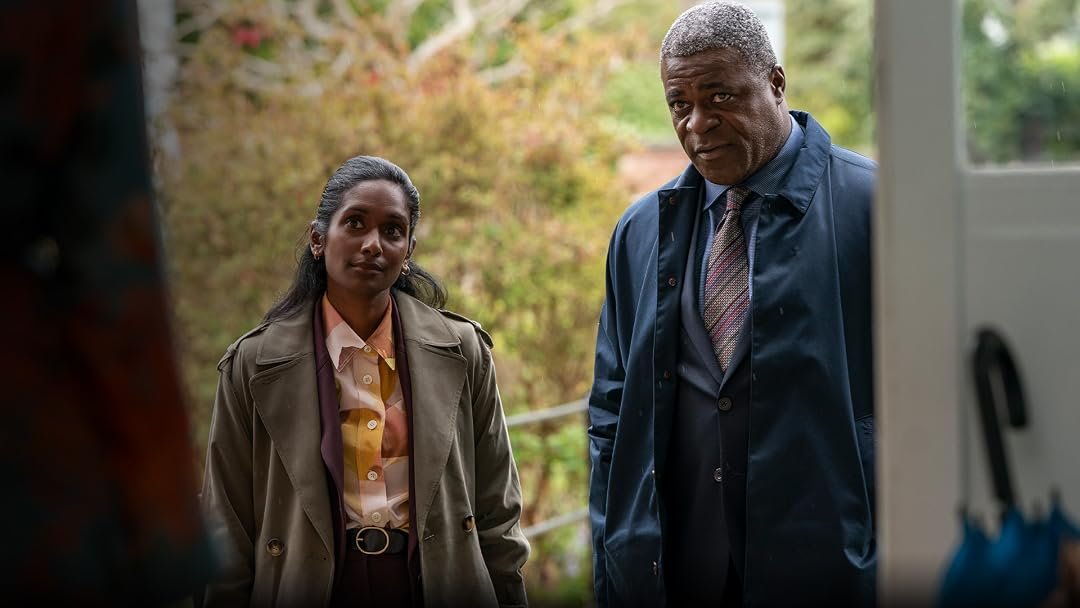
Warning: Spoilers ahead for the entire first season of Marble Hall Murders.
Marble Hall Murders ends with two murder mysteries coming together in a surprising way. One takes place in the real world, where editor Susan Ryeland investigates the suspicious death of Miriam Crace and the murder of her grandson, Eliot. The other unfolds inside Eliot’s unfinished detective novel, where Atticus Pünd investigates the poisoning of Lady Margaret Chalfont.
As the finale reveals, the answers are hidden in the manuscript Eliot leaves behind. Susan must understand how the fictional clues connect to the Crace family before the person responsible for the deaths can escape justice.
Marble Hall Murders Ending Explained: Who Killed Miriam Crace?
The person responsible for Miriam Crace’s murder is Frederick Turner, her adopted son, who is also her biological son. His real parentage is the key to understanding the entire mystery.
Miriam had an affair with her chauffeur, Bruno, and Frederick was born from that relationship. However, his true identity was concealed, and he grew up without knowing the full story of his birth. When Frederick eventually discovered the truth, he learned that Miriam had hidden his parentage and that his biological father had been sent away.
Frederick came to see Miriam’s actions as a betrayal. Rather than confront the past or accept what had happened, he decided to take revenge. He poisoned Miriam with arsenic obtained from the feathers of a taxidermy kingfisher in Kenneth Crace’s workshop.
The murder was not immediately recognised as a crime. Jonathan Crace bribed Dr Lambert to issue a death certificate that falsely recorded Miriam’s death as natural. This helped conceal the truth and allowed the family to continue living with the consequences of a crime that had never been properly investigated.
The mystery is especially cruel because the Crace family had already spent years hiding secrets, blaming one another and protecting its reputation. Miriam’s death was not simply the result of a family dispute. It was connected to a hidden history that Frederick could no longer ignore.
Why Did Frederick Turner Kill Eliot Crace?
Eliot was getting close to the truth about his grandmother’s death. He believed Miriam had been murdered and suspected that the answer could be found in his latest manuscript, Pünd’s Last Case.
At a family gathering, Eliot announces that he knows who killed Miriam. Frederick fears that Eliot has discovered his secret and will expose him. To stop that from happening, Frederick runs Eliot down with his car.
Eliot’s death is therefore directly connected to the old murder. Frederick had managed to hide his crime for around twenty years, but Eliot’s investigation threatened to destroy that carefully maintained secret.
There is an important distinction here: Eliot’s death does not prove that his suspicions about every member of the family were correct. His manuscript contains clues, false leads and fictional versions of real people. Susan has to separate Eliot’s assumptions from the facts before she can identify the actual killer.
How Does Eliot’s Unfinished Novel Reveal the Truth?
The most unusual part of Marble Hall Murders is its story-within-a-story structure. Susan is editing Eliot’s continuation of the Atticus Pünd detective series, but the manuscript appears to contain clues about the real murder of Miriam Crace.
Inside the novel, Pünd travels to Corfu and investigates the poisoning of Lady Margaret Chalfont. Her death occurs just before she can reveal important information and make changes to her will. The fictional investigation gradually begins to echo the circumstances surrounding Miriam’s death.
Susan realises that Eliot has used his novel to explore his suspicions about his own family. The characters and events are not always direct copies of real people, which makes the clues difficult to interpret. Nevertheless, details that initially seem unimportant become meaningful when compared with the evidence in the real case.
After Eliot dies, his manuscript remains unfinished. Susan and Detective Inspector Ian Blakeney must work through the surviving pages, notes and clues to understand what Eliot was trying to reveal. Blakeney eventually takes the unusual step of writing the missing ending himself, using the detective story to help solve the real murder.
This is more than a clever literary device. Eliot’s novel becomes his final attempt to communicate something he could not safely reveal in ordinary conversation. The fictional mystery provides a route into the real one, even though Susan must still test the clues against the evidence.
Also Read: Marshals Season 2 Episode 2 Recap and Review
Who Killed Lady Margaret Chalfont in Pünd’s Last Case?
The fictional murder is also resolved in the finale. Robert Waysmith, the son of Margaret’s second husband, Elmer Waysmith, is revealed as the killer behind the central crime in Eliot’s detective story.
Robert’s role is important because the fictional investigation mirrors the real family mystery. The people surrounding Margaret have financial motives, hidden relationships and reasons to mislead the investigation. As in the Crace family, the obvious suspects do not tell the whole story.
The solution also involves the attempt to direct suspicion away from the guilty person. The fictional clues and the real investigation reflect each other, showing how a murder can be hidden behind misleading evidence and family secrets.
The parallel between the two mysteries is central to the ending. Pünd solves a crime in the fictional world, while Susan and Blakeney use the same story to understand what happened outside it.
What Happens to Susan Ryeland?
Susan’s investigation puts her in danger, particularly after Eliot’s death. Elaine Clover, the wife of Charles Clover, helps frame Susan and makes it appear that the editor is responsible for Eliot’s murder. The attempt to shift suspicion places Susan under pressure while she is trying to uncover the truth.
With Blakeney’s help, Susan begins to expose the deception. Elaine eventually turns against Susan directly, leading to a final confrontation. Blakeney intervenes, and Elaine is arrested.
Once the case is resolved, Susan begins a new chapter in her professional life. She establishes her own publishing company, Nine Lives Books, and secures the rights to Eliot’s unfinished novel. Blakeney completes the manuscript under a pseudonym, allowing the book to reach readers despite Eliot’s death.
Susan also decides to publish a biography that reveals Miriam’s cruel nature and the darker truth behind the Crace family’s public image. This damages the reputation of Miriam’s work and affects the family’s commercial interests. Susan is no longer simply the editor who has been drawn into other people’s secrets; she has become someone willing to tell the truth on her own terms.
Do Susan and Ian Blakeney End Up Together?
Yes. The ending gives Susan and Ian a personal future beyond the investigation. Their relationship develops as they work together to uncover the truth, and the story closes with them as a couple.
Their relationship also marks a change for Susan. She has experienced betrayal, professional setbacks and the danger of becoming involved in another author’s mystery. With the case behind her, she can begin building a more stable life instead of being trapped in the problems created by other people.
Also Read: Treasure Island Season 1 Episode 1 Recap and Review
What Does the Ending of Marble Hall Murders Mean?
The ending is about more than identifying two killers. It explores the damage caused by secrets, the way families protect their reputations and the danger of allowing old resentment to shape the present.
Frederick’s anger has an understandable source: he discovers that important parts of his identity were hidden from him. But his suffering does not excuse the murders he commits. His decision to take revenge destroys more lives and creates another generation of grief.
The series also explores the relationship between fiction and reality. Eliot cannot finish his novel, yet his writing provides Susan with the clues needed to uncover the truth. A fictional detective story becomes a record of real suspicions, while its invented characters help disguise the people Eliot is trying to understand.
Ultimately, the finale suggests that a story can reveal the truth, but only when someone is prepared to look beyond its surface. Susan succeeds because she does not accept the first explanation offered to her. She reads carefully, questions the evidence and recognises the links between two apparently separate mysteries.
Also Read: Cupertino Season 1 Episode 1 Recap and Review
| Detail | Information |
|---|---|
| Title | Marble Hall Murders |
| Genre | Mystery, crime drama, detective fiction |
| Release year | 2026 |
| Based on | The novel Marble Hall Murders by Anthony Horowitz |
| Main character | Susan Ryeland, a book editor |
| Fictional detective | Atticus Pünd |
| Main real-world mystery | The murder of Miriam Crace and the death of Eliot Crace |
| Killer of Miriam Crace | Frederick Turner |
| Why Eliot is killed | Frederick fears that Eliot will expose the truth about Miriam’s murder |
| Fictional murder solution | Robert Waysmith is revealed as the killer in Pünd’s case |
| Investigator assisting Susan | DI Ian Blakeney |
| Ending | The murders are solved, Elaine is arrested, and Susan starts a new publishing venture |
Robert Waysmith is revealed as the killer in the fictional mystery featured in Eliot’s unfinished novel. The case mirrors the real investigation into the Crace family’s secrets.
Frederick killed Eliot because he feared that Eliot had discovered the truth about Miriam’s murder. When Eliot threatened to expose the killer, Frederick ran him over with his car.
Susan studies Eliot’s unfinished manuscript and connects its clues to the real events surrounding Miriam’s death. With help from Detective Inspector Ian Blakeney, she uncovers the truth behind the murders.
Elaine attempts to frame Susan and becomes involved in the final confrontation. Blakeney intervenes, and Elaine is arrested.
Yes, the ending points toward a future together for Susan and Ian after they work together to solve the case.