
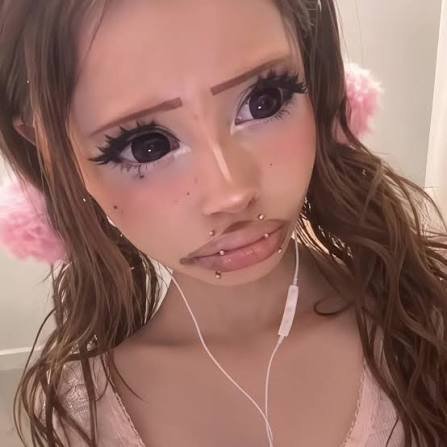
The Misery Girl meme usually shows a girl with heavy makeup, dark styling and several facial piercings, followed by a joke suggesting that her favorite song is “Misery” by Pupsies.
The joke became especially recognizable because of captions such as Dada turn on dat misery and Dad play Misery. What started as a simple stereotype about an alternative fashion style quickly turned into a larger meme format on TikTok and X.
What Does the Misery Girl Meme Mean?
“Misery Girl” is not really the name of a particular person. It is a fictional meme character based on an exaggerated version of an alt or goth girl.
The joke assumes that a girl with dramatic makeup, dark clothes and lots of piercings must be obsessed with the song “Misery” by Pupsies. Creators then exaggerate the character even further by writing captions in a childish or intentionally awkward style, especially variations of “dada play Misery.”
Part of the humor comes from treating a normal alternative fashion aesthetic as if everyone who looks that way shares the same personality, music taste and behavior. In other words, the meme is built around an exaggerated stereotype rather than an actual description of alt or goth people.
Misery Girl Meme Origin
The exact beginning of the Misery Girl meme is unclear, but its widely traced spread began on TikTok in August 2026.
One of the earliest widely documented examples appeared on August 12, 2026, when TikToker @the.scarred.one posted a video featuring an alt girl with several lip piercings. The caption joked, “How did you know my fav song is Misery?” The post reportedly received more than 12,000 views during its first week.
That post helped establish the basic idea behind the meme: heavily pierced alternative girls were humorously portrayed as being devoted to the song “Misery.” The format was then copied, exaggerated and combined with other internet jokes.
Also Read: Caturday Meme Meaning
How Did the Misery Girl Meme Go Viral?
The trend grew quickly during the middle of August 2026. On August 15, TikToker @doelilll posted an AI-edited video involving a Misery Girl asking “dada” to turn up “Miseryphonk.”
The meme also moved onto X. Around the same time, X user @bledgun posted an edited image using a photo of X user @himonkeyhamie, presenting her as the stereotypical Misery Girl on a fake album cover. The post gained more than 11,000 likes in under a week.
The biggest jump came on August 17, when TikToker @t.pearr posted a slideshow of Misery Girl images with the caption “Dada turn on dat misery.” The post reportedly reached more than 2.3 million views in four days.
By August 20, the trend had even inspired drawings and other creative versions. This showed how quickly the original joke had moved beyond a single image or video format.
Why Is Dada Play Misery Part of the Meme?
The “dada” wording is one of the main parts of the joke. Instead of simply saying that the character wants to listen to “Misery,” meme creators write captions such as “Dada play Misery” or “Dada turn on dat misery.”
This makes the character sound deliberately childish and creates an exaggerated contrast with the girl’s mature alternative appearance.
The joke also developed an ageplay-related implication, which became part of some versions of the meme. However, this is an internet stereotype used for the joke and should not be treated as a fact about the real people whose images appear in these memes.
The Connection to Himonkeyhamie
Photos of X user @himonkeyhamie became closely associated with the Misery Girl meme. Her alternative appearance was repeatedly used by meme creators as a visual representation of the fictional character.
This does not mean she created the meme or that she actually fits the personality being described by it. Her image simply became one of the recurring faces used in the format, much like a reaction image can become associated with a particular internet joke.
Also Read: When the Friend Group Is Separated So Everyone Is Experiencing Their Own Arc Meme
Misery Girl and Dream Girl Wallahi Meme
The Misery Girl trend also crossed over with the “Dream Girl Wallahi” meme format. Users would jokingly describe a Misery Girl as their “dream girl,” adding another layer to the original joke.
This crossover helped the meme spread because people could combine an already familiar meme phrase with the new Misery Girl character.
Why Did Some People Push Back Against the Meme?
As the trend became more popular, not everyone liked the way it portrayed alternative girls.
Some response posts pointed out that having heavy makeup, facial piercings or an alternative style does not automatically mean someone listens to “Misery,” participates in ageplay or behaves like the fictional character shown in the memes.
That criticism became part of the meme’s story. Some creators moved from simply mocking the aesthetic to defending it, while others treated the whole trend as harmless exaggeration.
Also Read: 2 Days Into College Meme Meaning and Origin
How the Misery Girl Meme Is Used
The format is fairly simple. A creator takes a picture, video or drawing of an alternative-looking girl and adds a caption suggesting that she desperately wants to hear “Misery” by Pupsies.
Common versions use phrases such as:
- “Dada turn on dat misery”
- “Dad play Misery”
- “How did you know my fav song is Misery?”
- Jokes about buying the “Misery” album for “Dada”
The wording, exaggerated personality and visual style are what make the format recognizable. Some versions are simple image memes, while others use TikTok videos, AI edits, drawings or slideshows.
| Information | Details |
|---|---|
| Meme name | Misery Girl |
| Also called | Misery Girls |
| Year | 2026 |
| Main platform | TikTok |
| Other platform | X (formerly Twitter) |
| Related song | “Misery” by Pupsies |
| Main aesthetic | Alt, emo and goth-style appearance |
| Common visual features | Heavy makeup, dark styling and facial piercings |
| Popular phrase | “Dada turn on dat misery” |
| Earliest widely traced example | August 12, 2026 |
| Early TikTok creator | @the.scarred.one |
| Recurring image associated with the meme | @himonkeyhamie |
| Peak spread | Mid-August 2026 |
Is Misery Girl a Real Person?
No. “Misery Girl” refers to a meme character and stereotype rather than one specific person.
Although real people’s photographs have been used in some versions of the meme, the “Misery Girl” personality is fictional and exaggerated for comedic purposes. One recurring face in the meme is @himonkeyhamie, but the meme has also used images of other alternative-style girls.
It is an exaggerated stereotype of an alt, emo or goth-style girl, usually shown with heavy makeup, dark styling and facial piercings.
Dada play Misery is a popular caption used in the meme. The deliberately childish wording is part of the joke.
Misery Girl is not one specific person. She is a fictional meme character based on an exaggerated alternative-girl stereotype.
No. Misery Girl is a fictional meme character, although real people’s photographs have been used to represent the character.