
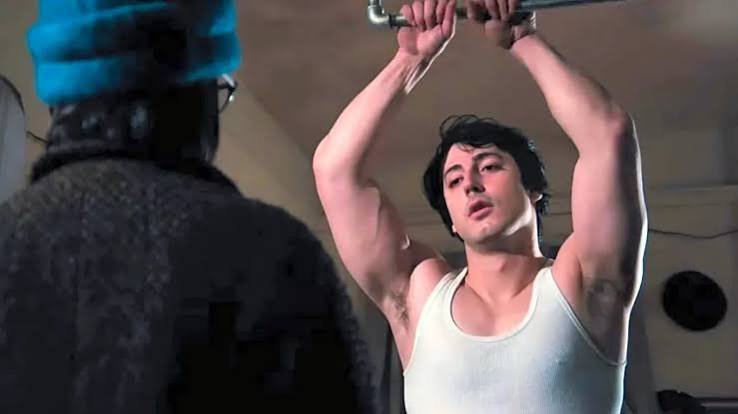
Spoilers ahead for I Play Rocky (2026).
I Play Rocky (2026) tells the remarkable story of how Sylvester Stallone went from a struggling actor with almost no money to the man behind one of Hollywood’s most famous boxing characters. Directed by Peter Farrelly and starring Anthony Ippolito as the young Stallone, the biographical drama follows his determination to write, produce and star in Rocky, even when Hollywood executives believe he is the wrong person for the leading role.
The biggest challenge is not writing the screenplay. Producers like the story, but they want an established actor to play Rocky Balboa. Stallone refuses to sell his script unless he gets the opportunity to play the character himself. His decision puts his financial future at risk, but he believes nobody else can bring his vision to life in quite the same way.
The ending brings this struggle to an emotional conclusion with the recreation of Rocky’s famous run up the Philadelphia Museum of Art steps. However, there is an interesting twist involving the original film’s final boxing match, which appears during the end credits rather than as the main climax of I Play Rocky.
I Play Rocky Plot Recap
The film introduces Sylvester Stallone as a struggling actor trying to find work in Hollywood. He attends auditions but rarely gets the opportunities he wants. Most of the roles offered to him are small parts, and his financial situation continues to get worse. Despite his acting struggles, Stallone has not given up on becoming a successful performer.
His life begins to change when he meets Sasha, played by AnnaSophia Robb. She becomes an important part of his life and encourages him to stop waiting for someone else to give him the right opportunity. If Hollywood is not offering him the roles he wants, he should create one himself.
Stallone takes that advice seriously. He starts writing screenplays, hoping to create a character that will allow him to show what he can do as an actor. After several unsuccessful attempts, he develops the story of Rocky Balboa, a small-time boxer who gets an unexpected opportunity to fight the heavyweight champion Apollo Creed.
The inspiration shown in the film comes from the real boxing match between Muhammad Ali and Chuck Wepner in March 1975. Wepner was considered a major underdog, but he managed to survive against Ali for 15 rounds. His determination becomes an important part of the film’s explanation of how Stallone developed the Rocky story.
Stallone completes the screenplay and approaches producers Irwin Winkler and Robert Chartoff. They recognise its potential and want to turn it into a movie. However, there is one major problem: they do not want Stallone playing the lead character.
Why Does Stallone Refuse to Sell the Rocky Script?
When producers Irwin Winkler and Robert Chartoff show interest in the screenplay, Stallone finally sees a chance to change his life. But the producers have a different plan for the movie. They believe an established Hollywood actor would attract a bigger audience and make the project easier to sell.
They are willing to pay Stallone for the screenplay, but they do not believe an unknown actor with limited experience should lead such an important production. From their perspective, separating the writer from the leading role is simply a safer business decision.
Stallone disagrees. He has written Rocky as a character he understands personally. The boxer’s struggles, rejection and determination reflect many of the difficulties he has experienced in his own life. He does not want to hand over the character to another performer after spending so much time creating him.
He repeatedly refuses the producers’ offers, even when they increase the amount of money. For someone struggling financially, turning down such an opportunity is a dangerous decision. However, Stallone believes that accepting the deal without getting the lead role would mean giving up the most important part of his dream.
His famous position is simple: he wants to play Rocky. Eventually, the producers understand that they cannot get the movie they want without reaching an agreement with him.
Does Sylvester Stallone Finally Get to Play Rocky?
Yes, Stallone eventually gets the opportunity to play Rocky Balboa. However, the agreement comes with a major compromise. The producers are not prepared to take the same financial risk they originally considered, so the production budget is reduced to approximately $1 million.
This is a significant change. The filmmakers now have very limited money and cannot afford unnecessary delays or expensive production decisions. Stallone gets the role he has been fighting for, but he also has to prove that the movie can be completed under these difficult conditions.
The reduced budget puts pressure on everyone involved. The production must work quickly, the locations and equipment have to be used carefully, and there is very little room for mistakes. Stallone also faces the challenge of performing as Rocky while helping bring his screenplay to the screen.
This is an important turning point because his victory is not simply about convincing the producers to cast him. He now has to show that their decision was worth the risk.
Also Read: Campus Drivers Season 1 Recap and Ending Explained
What Happens in the Mickey and Rocky Scene?
One of the most emotional moments in I Play Rocky involves the scene between Rocky and his trainer Mickey. In the original Rocky, Mickey initially overlooks Rocky and gives his locker-room position to another boxer. Rocky feels rejected because the trainer has ignored him for years despite knowing his abilities.
Later, Mickey approaches Rocky and offers to train him for his upcoming fight against Apollo Creed. However, Rocky is not ready to forget how he was treated. Their conversation becomes an emotional confrontation about missed opportunities, respect and the feeling of being overlooked.
In I Play Rocky, this sequence also carries a personal meaning for Stallone. The emotional performance reflects his own experiences with rejection and the frustration of being underestimated. The scene is particularly important because it allows the character to express something deeper than his ambition to become a successful boxer.
Director Peter Farrelly recreates the moment as one of the major acting challenges for Anthony Ippolito. He has to capture the emotional intensity of a famous scene without making the performance feel like a simple imitation of Stallone.
How Does the Philadelphia Museum of Art Scene End the Movie?
The main story reaches its emotional high point with the recreation of Rocky’s famous run up the steps of the Philadelphia Museum of Art.
In the original 1976 film, Rocky runs through the streets of Philadelphia as part of his training. He eventually reaches the top of the museum steps and raises his arms in celebration. The moment becomes one of the most recognisable scenes in sports movie history.
In I Play Rocky, the same sequence has a different meaning. The audience has spent the film watching Stallone struggle to get his screenplay accepted and convince the producers to let him play the lead. Now, he is finally filming the character he refused to give up.
The climb represents more than Rocky’s physical training. It also represents Stallone’s journey from an unknown actor to the star of a major Hollywood production. He has overcome financial problems, rejection and pressure from the producers to reach this moment.
The sequence also highlights the importance of the Steadicam, which helped create the smooth moving camera shots used in the original Rocky. Garrett Brown, the inventor of the Steadicam, played an important role in making the running sequence possible. In I Play Rocky, this part of the filmmaking history is recreated through Michael Fuchs.
By reaching the top of the steps, Stallone’s character achieves the dream he has been fighting for throughout the movie. It is the perfect emotional ending because the story is ultimately about how Rocky was made, not simply about what happens inside the boxing ring.
Why Is the Rocky vs Apollo Creed Fight Shown During the End Credits?
One of the most surprising decisions in I Play Rocky is that the famous fight between Rocky Balboa and Apollo Creed does not serve as the main climax of the movie.
Director Peter Farrelly originally planned to include the boxing match as part of the film’s final sequence. The production even spent considerable time recreating the fight. However, after reviewing the finished material, Farrelly felt that the Philadelphia Museum of Art scene already provided a stronger emotional conclusion.
The problem was that showing the fight immediately after the running sequence would create two major climaxes. The audience would first experience Stallone achieving his dream and then be asked to watch another lengthy sequence that belonged to the original Rocky story.
Farrelly decided to move the boxing match into the end credits instead. This allowed him to keep the emotional impact of the Philadelphia steps while still showing audiences a recreation of the iconic Rocky and Apollo Creed fight.
Importantly, the fight was not removed because it could not be completed. It was a creative editing decision. The main story ends when Stallone finally brings his vision to life, while the credits offer a glimpse of the famous sporting moment that made Rocky such a memorable film.
Also Read: American Hostage Season 1 Recap and Ending Explained
What Happens to Sylvester Stallone After Rocky Is Made?
Although I Play Rocky focuses mainly on the difficult journey of getting the original movie made, its ending reminds viewers of what happened after Stallone finally got his opportunity.
The original Rocky became a major success after its release in 1976. The film received 10 Academy Award nominations and won three Oscars, including Best Picture, Best Director and Best Film Editing. Stallone also received nominations for Best Actor and Best Original Screenplay.
This achievement makes the story even more remarkable. The producers initially believed that an unknown actor would not be able to carry a boxing drama. Yet the same actor they were reluctant to cast became the face of a character that would remain popular for decades.
Rocky Balboa eventually became one of the most recognisable characters in cinema. The success also changed Stallone’s career and established him as a major Hollywood star.
What Happens in the Final Johnny Carson Scene?
I Play Rocky has another interesting moment at the very end of its credits. The film uses archival footage of the real Sylvester Stallone appearing on Johnny Carson’s The Tonight Show to promote the original Rocky.
This is different from the recreated scenes featuring Anthony Ippolito. Instead of watching another dramatic moment from Stallone’s younger life, viewers get to see the actual actor after his hard work has finally paid off.
The appearance creates a connection between the story told throughout I Play Rocky and the real events that followed. At the beginning, Stallone is a struggling actor who cannot get the leading roles he wants. By the end, he is appearing on a major television programme to discuss a movie that has become a Hollywood success.
The footage also brings the story full circle. The audience has watched the fictionalised version of Stallone fight for the opportunity to play Rocky. Now, the real Stallone appears on screen as proof of what that decision eventually achieved.
It is better understood as archival end-credit footage rather than a traditional post-credit scene. It does not introduce a new storyline or tease a sequel. Instead, it provides a final connection to the real history behind the movie.
Is the Ending of I Play Rocky Based on a True Story?
Yes, the central events behind the ending are based on Sylvester Stallone’s real-life experiences. He wrote the Rocky screenplay, insisted on playing the leading role and eventually convinced the producers to make the film with him as Rocky Balboa.
The original movie was also made on a very limited budget compared with many major Hollywood productions. Its success eventually proved that a film did not need an established superstar to connect with audiences.
However, I Play Rocky is a biographical drama, not a documentary. Some conversations and events are dramatised, and certain characters are fictionalised or represent a combination of real people. Sandy Maddox, for example, is a composite studio executive rather than a direct portrayal of one specific individual.
The movie also presents the inspiration behind Rocky in a dramatic way. The Muhammad Ali and Chuck Wepner fight is associated with the screenplay’s development, although Stallone’s own accounts of the exact inspiration have not always matched that simplified version.
Therefore, the film should be viewed as a dramatic retelling of the struggle behind Rocky rather than a completely detailed record of every event.
Also Read: Nuisance Bear 2026 Recap and Ending Explained
What Does the Ending of I Play Rocky Really Mean?
The ending is about believing in your own work when other people cannot see its potential. Throughout the film, Stallone faces rejection because Hollywood executives do not believe he is the right person to play the character he created.
He could have accepted the money, sold the screenplay and walked away with a much easier financial future. Instead, he chooses to take a risk because playing Rocky is an essential part of his creative vision.
The Philadelphia Museum of Art sequence brings this idea together. Rocky reaches the top of the steps in the fictional story, while Stallone reaches the top of his own professional struggle. Both moments represent determination and the refusal to accept that difficult circumstances must decide the future.
The decision to move the Apollo Creed fight into the credits also supports this meaning. The biggest victory in I Play Rocky is not a boxing result. It is Stallone finally getting the opportunity to make the movie on his own terms.
The final Johnny Carson footage adds one last reminder that this was not just a fictional underdog story. The real Stallone eventually achieved what his younger self had been fighting for.
Also Read: Wild Horse Nine Recap and Ending Explained
| Details | Information |
|---|---|
| Movie Title | I Play Rocky |
| Release Year | 2026 |
| Genre | Biographical Drama |
| Director | Peter Farrelly |
| Writer | Peter Gamble |
| Young Sylvester Stallone | Anthony Ippolito |
| Sasha | AnnaSophia Robb |
| Irwin Winkler | P.J. Byrne |
| Robert Chartoff | Toby Kebbell |
| John Avildsen | Jay Duplass |
| Sandy Maddox | Tracy Letts |
| Apollo Creed | Stephan James |
| Production Budget in the Story | Approximately $1 million |
| Story Inspiration | The making of the original 1976 Rocky |
| Main Ending | Rocky’s famous run up the Philadelphia Museum of Art steps |
| End-Credit Highlight | Rocky vs Apollo Creed fight and archival Stallone footage |
| Central Theme | Determination, creative freedom and believing in yourself |
Yes. Stallone refuses to sell his screenplay unless he gets the opportunity to play the lead character. Eventually, the producers agree to his demand, although the production budget is reduced.
Yes. The film is based on Sylvester Stallone’s real-life struggle to write and star in Rocky. However, some conversations, characters and events are dramatised for storytelling purposes.
Stallone believes he is the right person to play Rocky Balboa because he understands the character and has personally connected with his struggles. He refuses to give up the leading role, even when producers offer him money for the screenplay.