
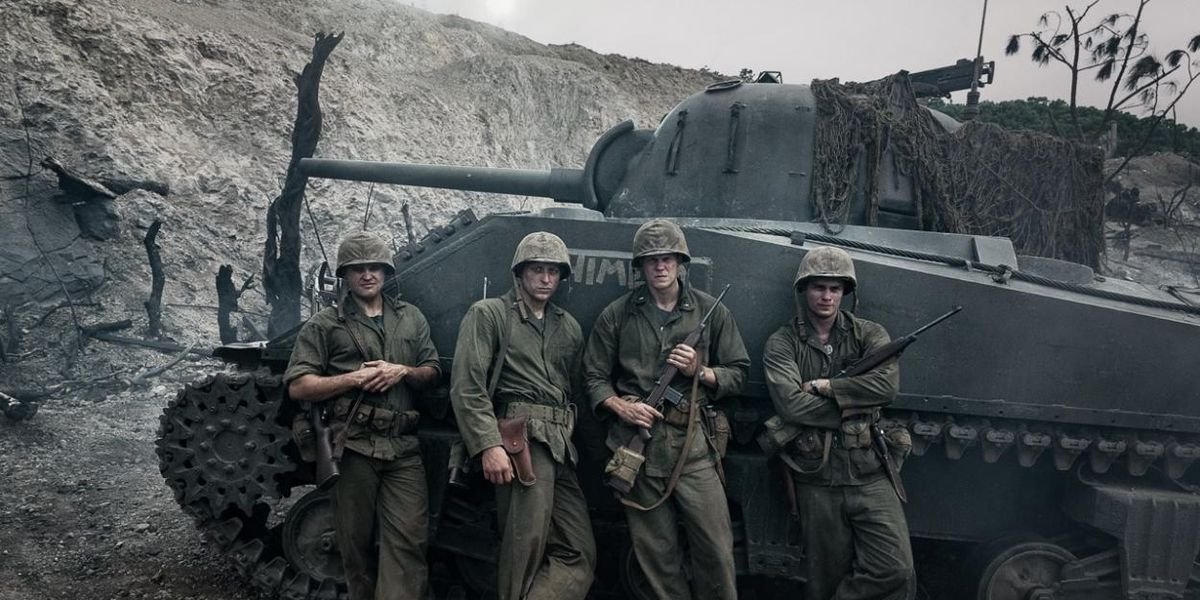
The Mosquito Bowl (2026) is a World War II drama about four college football stars whose promising futures are interrupted by the war. Directed by Peter Berg, the film follows John McLaughry, Bob Bauman, Tony Butkovich, and Dave Schreiner as they leave their football careers behind and join the United States Marine Corps. But what happens to them after the famous football game on Guadalcanal? Let’s break down the ending and the real meaning behind the final scenes.
What Is The Mosquito Bowl About?
The story begins in 1941, when four young men are building promising futures through college football. John McLaughry, Bob Bauman, Tony Butkovich, and Dave Schreiner are talented athletes who have everything ahead of them. Their biggest concerns are football, friendships, relationships, and the possibility of playing professionally.
However, their lives change after Japan attacks Pearl Harbor on December 7, 1941. The United States enters World War II, and the four men decide to put their sporting ambitions aside and join the Marine Corps.
Their journey takes them away from college campuses and into the dangerous Pacific Theater. They experience military training, the pressures of combat, and the loss of friends. The film shows how quickly their understanding of life changes when they discover that the battlefield is nothing like a football field.
Despite their different personalities, the four men develop a strong connection. Their friendship becomes especially important because they are facing the same dangers while missing the lives they left behind.
What Is the Origin of the Mosquito Bowl?
The title comes from a real football game played by United States Marines on Guadalcanal on December 24, 1944.
The match brought together former college football players from the 4th and 29th Marine Regiments. Many of these men had been talented athletes before joining the military. The game gave them an opportunity to enjoy football again during a period when their everyday lives were dominated by war.
The event became known as the Mosquito Bowl. It was played under unusual conditions, and the match ended in a 0–0 tie.
The result was not important to the soldiers. What mattered was the opportunity to forget about combat for a little while. They could compete, laugh, and reconnect with something that reminded them of their lives before the war.
The real story was later documented by journalist Buzz Bissinger in his 2022 nonfiction book, The Mosquito Bowl: A Game of Life and Death in World War II. Peter Berg adapted this book into the 2026 film.
Also Read: Collision Course 2026 Movie Recap Ending Explained
| Information | Details |
|---|---|
| Movie | The Mosquito Bowl |
| Release Year | 2026 |
| Genre | War, Historical Drama |
| Director | Peter Berg |
| Writers | Peter Berg and Mark L. Smith |
| Based On | The Mosquito Bowl by Buzz Bissinger |
| Nicholas Galitzine | John McLaughry |
| Bill Skarsgård | Bob Bauman |
| Ray Nicholson | Tony Butkovich |
| Tom Francis | Dave Schreiner |
| Story Setting | World War II |
| Main Location | Pacific Theater |
| Important Historical Event | The Mosquito Bowl on Guadalcanal |
The Mosquito Bowl Ending Explained: Who Survives the War?
The ending reveals that John McLaughry is the only one of the four central football players who survives World War II. Bob Bauman, Tony Butkovich, and Dave Schreiner are killed during the Battle of Okinawa.
After the football game on Guadalcanal, the Marines return to their military duties. The brief happiness they experienced during the match cannot protect them from the violence waiting ahead.
The Battle of Okinawa becomes the most devastating part of their journey. The four men who once shared the same sporting ambitions now face a future that none of them can predict.
Tony, Bob, and Dave lose their lives, while John manages to survive and return home.
This is the emotional heart of the ending. The four men began their journey with similar dreams, but war gives them very different outcomes. Their athletic abilities, courage, and friendship cannot guarantee that they will all make it home.
John’s survival is not presented as a traditional happy ending. He gets another chance at life, but his three friends are gone. He must continue living with the memories of the people who shared his journey.
What Happens to Tony Butkovich?
Tony Butkovich, played by Ray Nicholson, is one of the most talented football players in the story. Before joining the Marines, he had built an impressive reputation through his athletic performances.
His rivalry with Dave Schreiner is an important part of his earlier life. However, military service changes their priorities. The competition that once mattered on the football field becomes less important when they are fighting to survive.
Tony is killed by sniper fire during the Battle of Okinawa on April 18, 1945.
His death is especially tragic because he had a promising future in professional football. He had been selected in the first round of the 1944 NFL Draft by the Cleveland Rams, but he never got the chance to play professionally.
His story shows how war can take away opportunities that once seemed almost certain. Tony had the talent and ability to build a successful sporting career, but he never returned home to pursue it.
Also Read: The Birthday Gift 2026 Recap
What Happens to Dave Schreiner?
Dave Schreiner, played by Tom Francis, was an All-American football player at the University of Wisconsin. He was also one of the most thoughtful members of the group.
His friendship with Bob Bauman is particularly important. Bob is more relaxed and playful, while Dave is often serious and self-critical. Their different personalities make their friendship an important emotional part of the film.
Dave also has a relationship with Odette Hendrickson, his fiancée. Their letters show how deeply he misses home and the people he loves.
Unfortunately, Dave does not survive the Battle of Okinawa. He is mortally wounded on June 20, 1945, and dies the following day.
Like Tony, Dave had been selected in the first round of the NFL Draft, by the Detroit Lions in 1943. His professional football career never began.
His death is particularly painful because it happens near the end of the Okinawa campaign. After everything he has experienced, he still does not get the chance to return to his former life.
What Happens to Bob Bauman?
Bob Bauman, played by Bill Skarsgård, is Dave Schreiner’s close friend. Unlike Dave, Bob has a more carefree personality. He often brings humour and energy to their friendship.
Their connection is one of the most meaningful relationships in the film. They share their football experiences and later face the difficulties of military service together.
However, Bob is also killed during the Okinawa campaign.
His death reinforces the film’s central message about the unpredictable nature of war. Before the conflict, he was a talented athlete with friends, ambitions, and a future to look forward to. None of those things could protect him from the dangers of combat.
His loss also makes Dave’s story more heartbreaking because the two friends who shared so much of their lives never get the opportunity to return home together.
What Happens to John McLaughry?
John McLaughry, played by Nicholas Galitzine, is the only one of the four main characters who survives the war.
Before enlisting, John was a football player at Brown University. He was also interested in painting and came from a family with a strong connection to football.
Throughout the story, John is presented as a thoughtful and responsible person. His leadership qualities make him an important member of the group.
After surviving the war, John returns to civilian life and continues his connection with football. In real life, he later worked as a football coach at institutions including Union College, Amherst, and Brown University.
He died in 2007.
His future creates a strong contrast with the lives of Tony, Bob, and Dave. John gets the opportunity to continue doing something he loves, while his friends never get that chance.
However, his survival does not make the ending completely happy. He has lost three people who shared his experiences, and their absence becomes part of the life he continues to live.
Also Read: Dark Matter Season 2 Recap and Ending Explained
What Does the Final Atomic Bomb Montage Mean?
The final montage takes the story beyond the four football players and connects their experiences to the wider destruction of World War II.
The film shows images connected to Hiroshima and Nagasaki, Japanese survivors, American soldiers returning home, and the Statue of Liberty.
The atomic bomb imagery is particularly important because it reminds viewers that the war affected far more than the soldiers fighting on the battlefield.
The destruction of Hiroshima and Nagasaki caused enormous suffering among Japanese civilians. By including these images, the film expands its focus from the personal losses of four Marines to the human cost of the entire conflict.
The Statue of Liberty offers a different image. It represents America, freedom, and the country that the surviving soldiers return to after the war.
However, placing this image alongside scenes of destruction creates a complicated ending. The war may be over, but the suffering cannot simply disappear.
The montage reminds viewers that victory does not erase the lives lost or the damage caused by war.
Why Does the Film Show Soldiers Returning Home?
The returning soldiers represent the possibility of starting again after World War II.
At the beginning of the film, the four football players leave their homes, families, and sporting ambitions to serve their country. By the end, only John survives among the four central characters.
The images of soldiers coming home create a contrast between those who get another opportunity to live and those who never return.
For John, returning home means continuing his life outside the military. But the ending also reminds us of the families waiting for loved ones who will never come back.
These scenes are not simply about celebrating the end of the war. They are about the people who survived and the people whose lives were permanently changed by the conflict.
Also Read: Breeder (2026) Movie Recap and Ending Explained
Is The Mosquito Bowl Based on a True Story?
Yes. The film is based on real people and a historical football game played during World War II.
John McLaughry, Bob Bauman, Tony Butkovich, and Dave Schreiner were real college football players who served in the Marine Corps.
The actual Mosquito Bowl took place on Guadalcanal on Christmas Eve 1944. It brought together former college football players serving in the 4th and 29th Marine Regiments.
The story was documented in Buzz Bissinger’s nonfiction book, The Mosquito Bowl: A Game of Life and Death in World War II, published in 2022.
However, the movie is a dramatic adaptation, not a documentary. Some conversations, character interactions, and timelines have been changed or shortened to make the story work on screen.
The main historical tragedy remains the same: three of the four central men died during the Okinawa campaign, while John McLaughry survived.
John McLaughry is the only one of the four central football players who survives the war. Bob Bauman, Tony Butkovich, and Dave Schreiner are killed during the Battle of Okinawa.
Tony Butkovich is killed by sniper fire during the Battle of Okinawa on April 18, 1945. Despite being selected in the first round of the 1944 NFL Draft, he never gets the opportunity to play professional football.
Yes. Dave Schreiner is mortally wounded during the Battle of Okinawa on June 20, 1945, and dies the following day. He never gets the chance to return to his fiancée or resume his football career.
Bob Bauman is killed during the Okinawa campaign. His death is another heartbreaking loss for the group, particularly because of his close friendship with Dave Schreiner.
John McLaughry survives World War II and returns to civilian life. He later works as a football coach at several institutions, including Union College, Amherst, and Brown University. He dies in 2007.