
Warning: Major spoilers ahead for Monster: The Lizzie Borden Story Season 1.
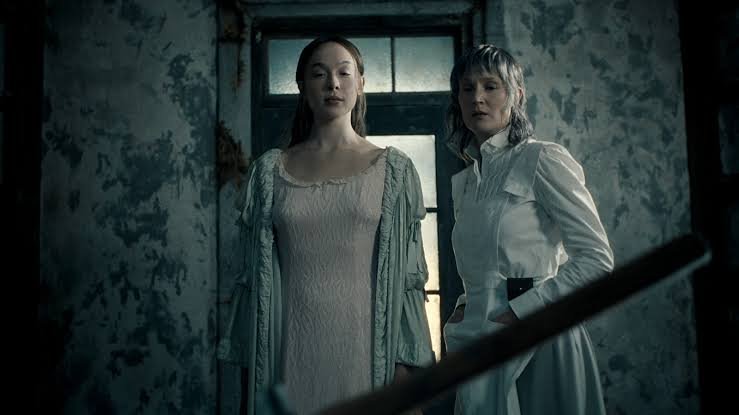
Monster: The Lizzie Borden Story takes one of America’s most famous unsolved murder cases and turns it into a dark story about family, control, freedom, violence, and the way a person can become trapped by their own reputation. The eight-episode Netflix season stars Ella Beatty as Lizzie Borden, Vicky Krieps as Bridget “Maggie” Sullivan, Charlie Hunnam as Andrew Borden, and Rebecca Hall as Abby Borden.
The real Lizzie Borden was accused of killing her father, Andrew Borden, and her stepmother, Abby Borden, in Fall River, Massachusetts, in 1892. She was acquitted at trial in 1893, and nobody else was ever convicted for the murders. The Netflix series takes that historical mystery and adds its own fictional interpretation of what may have happened inside the Borden household.
What Happens at the End of Monster: The Lizzie Borden Story?
By the final episodes, Lizzie’s carefully controlled life has completely changed. The anger and frustration that have been building throughout the season finally turn into violence. The murders of Andrew and Abby become the central event around which the rest of Lizzie’s life is shaped.
After the killings, Lizzie and Maggie are forced to deal with the consequences of what has happened. Their earlier dreams of escaping the oppressive Borden household no longer feel romantic or exciting. They have to live with fear, suspicion, and the possibility that the truth will come out.
The final episode, titled “Carnival,” moves beyond the murder itself and focuses on Lizzie’s attempt to live with the identity that has been created around her. Netflix describes the finale as the point where the weight of Lizzie’s “monstrous legacy” threatens to overwhelm her as she searches for a way forward.
Also Read: Last Seen Season 1 Episode 3 Recap and Ending Explained
Does Lizzie Get Acquitted?
Yes. The series follows the historical outcome of the case: Lizzie is found not guilty.
The trial becomes another important part of the story because Lizzie’s public image works in her favor. The prosecution has to convince the jury that a respectable Victorian woman could have committed such brutal murders. The defense, meanwhile, presents Lizzie as a woman who does not fit the image of a violent killer.
This creates one of the show’s central ironies. The same society that gives Lizzie very little control over her own life also has a difficult time accepting the idea that she could be capable of extreme violence.
Historically, the evidence against Lizzie was largely circumstantial. She was acquitted by an all-male jury after her 1893 trial, and the murders remain unsolved.
What Happens to Lizzie After the Trial?
Lizzie’s acquittal does not give her a normal life. Legally, she is free, but the public suspicion surrounding her never completely disappears.
After the trial, Lizzie and her sister Emma inherited money from their father’s estate and purchased a large home in Fall River. They called the house Maplecroft. Lizzie also began using the name Lizbeth as she attempted to create a new identity for herself.
On the surface, this looks like the freedom Lizzie wanted. She has money, a beautiful house, and far more control over her life than she had inside her father’s home.
But there is a catch.
She cannot escape the Borden murders.
People continue to associate her with the killings, and the story surrounding her becomes bigger than the woman herself. Instead of simply being Lizzie Borden, she becomes the woman accused of killing her parents.
Why Does Maplecroft Matter?
Maplecroft represents both freedom and isolation.
Lizzie finally has the kind of home and independence that were difficult to imagine during her life under Andrew Borden’s control. Yet the new house cannot erase what happened.
That is an important idea in the ending. Lizzie escapes one kind of prison, but another follows her.
The old prison was her family home. Her father controlled money and much of the household. The new prison is her reputation.
She can leave the Borden house, but she cannot leave the Borden story.
Also Read: Slow Horses Season 6 Episode 1 Recap and Ending Explained
What Happens to Lizzie and Maggie?
The relationship between Lizzie and Maggie is one of the major fictional elements of the series. The show uses their relationship to explore Lizzie’s desire for affection, independence, and a life outside the rules of her family.
As the story moves toward the murders and their aftermath, however, that dream becomes much harder to maintain. The violence changes their relationship and makes the future they imagined together far more complicated.
This is an important distinction when discussing the series. The real historical record does not establish the romantic relationship shown between Lizzie and Bridget Sullivan. The Netflix drama uses that relationship as part of its fictional interpretation of Lizzie’s story. Modern accounts of the case also stress that the historical murders themselves remain unsolved.
Was Lizzie Borden Really Guilty?
This is where the real history and the Netflix drama need to be separated.
Historically, there is no proven answer.
Lizzie was accused of killing Andrew and Abby Borden, but she was acquitted. No alternative suspect was convicted, and the case has remained one of America’s most famous unsolved murder mysteries.
Monster: The Lizzie Borden Story, however is a scripted drama. It takes the known historical events and fills in gaps with imagined relationships, motives, conversations and events. Netflix itself presents the season as a dramatized story about Lizzie, her household, and the circumstances surrounding the murders.
So viewers should not treat every event shown in the series as something that historians have proved happened.
Also Read: Marble Hall Murders Season 1 Episode 2 Recap and Ending Explained
What Is the Meaning of the Ending?
The ending is less about solving the historical mystery and more about showing what happens when a person becomes trapped inside a legend.
Lizzie wanted freedom. The series presents her as someone who spent years living under family restrictions and social expectations. The murders become the most extreme possible break from that life.
But freedom comes at a terrible cost.
Lizzie is legally free after the trial, yet she is never completely free from suspicion. Her name becomes connected to the murders forever. Her personal identity gradually disappears behind the public image of “Lizzie Borden.”
That is why the ending feels darker than a simple courtroom victory.
She survives the trial, but she cannot return to the person she was before the murders.
Why Is the Ending Connected to Female Rage?
One of the main themes of this season is female rage. The show places Lizzie inside a society where women, especially women from respectable families, were expected to follow strict rules about behavior, family, sexuality, and independence.
The series does not simply use those pressures to excuse Lizzie’s violence. Instead, it asks what happens when anger is kept inside for years and when a person feels that ordinary ways of gaining independence are closed off.
This idea also connects to the season’s use of Aileen Wuornos, played by Sarah Paulson. Wuornos is not part of Lizzie’s historical story, but the series uses her as a later example of a notorious woman whose life became part of America’s fascination with female killers.
The connection is therefore thematic rather than historical. Lizzie and Wuornos belong to completely different periods and circumstances, but the show places their stories alongside each other to explore how society remembers women who commit extreme violence.
Also Read: The Walking Dead: Dead City Season 3 Recap and Ending Explained
Real History vs. Netflix’s Story
| Point | What the Series Shows | What History Confirms |
|---|---|---|
| Lizzie Borden | Played by Ella Beatty and presented through a highly dramatized interpretation. | Lizzie Borden was a real woman who was accused of killing her father and stepmother. |
| Andrew Borden | Played by Charlie Hunnam. | Andrew Borden was murdered in his Fall River home on August 4, 1892. |
| Abby Borden | Played by Rebecca Hall. | Abby was Lizzie’s stepmother and was also murdered on August 4, 1892. |
| Bridget Sullivan | Played by Vicky Krieps and given a major relationship with Lizzie in the drama. | Bridget Sullivan was the Borden family’s maid. The romantic relationship shown by the series is not established as historical fact. |
| The murders | The series presents its own dramatized explanation of what happened. | The murders remain officially unsolved. |
| The trial | Lizzie’s trial becomes a major part of the final story. | Lizzie was tried in 1893 and acquitted. |
| Maplecroft | Represents Lizzie’s life after the trial and her attempt to live freely. | Lizzie and Emma later purchased a large home called Maplecroft. |
| Lizzie’s later life | The ending focuses on the emotional and social cost of becoming a famous murder figure. | Lizzie remained a controversial figure until her death in 1927. |
What Really Happened to Lizzie Borden?
After her acquittal, Lizzie remained in Fall River with her sister Emma for several years. Their new life was financially comfortable, but Lizzie never completely escaped the public’s suspicion.
In 1905, Emma moved out of Maplecroft after the sisters had a falling-out. The exact reason for their separation has never been firmly established. Lizzie continued living a relatively private life and died in 1927 at the age of 66. Emma died only nine days later.
Also Read: Go Team Ending Explained
Why the Ending Works as a Horror Story
The most frightening part of the ending is not simply the violence. It is the idea that Lizzie can never completely return to an ordinary life.
She wins her freedom through the legal system, but her name becomes permanently connected to a crime that has never been fully explained.
That gives the finale a tragic quality. Lizzie escapes the control of her family, but she becomes controlled by something else: the legend built around her.
More than a century later, people are still asking the same basic questions about the Borden murders. That is exactly why the story continues to appear in books, films, television shows, and true-crime discussions.
After her acquittal, Lizzie remains in Fall River and eventually lives with her sister Emma at Maplecroft. Although she is legally free, public suspicion continues to follow her.
Maplecroft is the large home where Lizzie and her sister Emma live after the trial. It represents Lizzie’s attempt to build an independent life away from her father’s control.
Yes. Lizzie is acquitted after being accused of murdering her father, Andrew Borden, and her stepmother, Abby Borden. This follows the real historical outcome of the 1893 trial.
The series gives Lizzie and Bridget, also known as Maggie, a significant romantic relationship. However, this relationship is part of the show’s fictionalized storytelling and is not established as historical fact.